|
|

楼主 |
发表于 31-5-2009 07:20 AM
|
显示全部楼层
What Will Economic Recovery Look Like?by
bonddad  

Sat May 30, 2009 at 05:21:13 AM PDTOver the last few months we're had several important signs that the economy may be bottoming.
The Conference Board has recently reported that
leading indicators
spiked up last month andconsumer confidence
has improved. In addition, the number of people who say the country is on the right track has been
increasing since October,
while the number of people who say the economy isgetting better is increasing.
We've possibly seen a bottom in
retail sales
and
durable goods orders. Finally, it appears that the four-week moving average of initial jobless claims as topped out. While all of this is preliminary data which could change given the volatile nature of the economy, things do appear to be moving forward. That means we need to start looking at what kind of recovery we'll see. And in that category there is a great deal of concern about what will actually drive growth.
To illustrate this issue, let's break US GDP down into its four components. Personal consumption expenditures, gross private domestic investment, exports and government spending.
Personal consumption expenditures account for 70% of US economic growth. Unfortunately, the US consumer does not appear ready to lead the economy out of recession. The main issue is US households are
heavily indebted:
U.S. household leverage, as measured by the ratio of debt to personal disposable income, increased modestly from 55% in 1960 to 65% by the mid-1980s. Then, over the next two decades, leverage proceeded to more than double, reaching an all-time high of 133% in 2007. That dramatic rise in debt was accompanied by a steady decline in the personal saving rate. The combination of higher debt and lower saving enabled personal consumption expenditures to grow faster than disposable income, providing a significant boost to U.S. economic growth over the period.
In the long-run, however, consumption cannot grow faster than income because there is an upper limit to how much debt households can service, based on their incomes. For many U.S. households, current debt levels appear too high, as evidenced by the sharp rise in delinquencies and foreclosures in recent years. To achieve a sustainable level of debt relative to income, households may need to undergo a prolonged period of deleveraging, whereby debt is reduced and saving is increased.
Here is the accompanying chart:
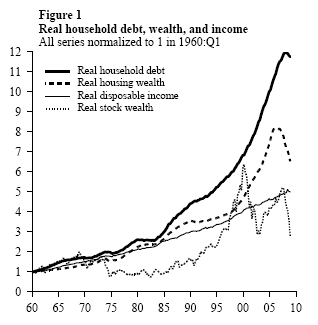
Simply put, US households have gone on a debt acquisition binge over the last 30 years. The primary event forcing them to deleverage is the massive loss of assets over the last few years thanks to the stock and housing market corrections. According to the
Federal Reserve,
household wealth has decreased from $64.361 trillion in 2Q07 to $51.476 trillion in 4Q08, or a decrease of 20%. This decrease means households have fewer assets relative to debt, meaning households are in fact poorer. This in turn forces consumers to pay down debt at the expense of spending. In summation, there is little reason to think that consumers will return in droves to the malls. It is far more likely they will consume less, leading to a slower recovery.
Next, there is investment. Here is a chart of the percentage change from the preceding quarter in gross private domestic investment.
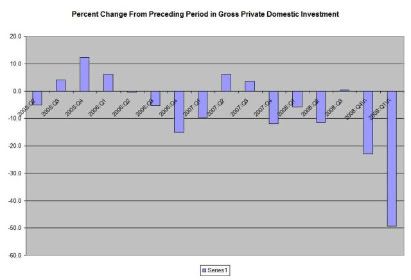
Notice how this number has been negative for nine of the last 12 quarters. In other words, the US economy is already in an investment recession. And there is little reason to think we'll be coming out of it anytime soon.
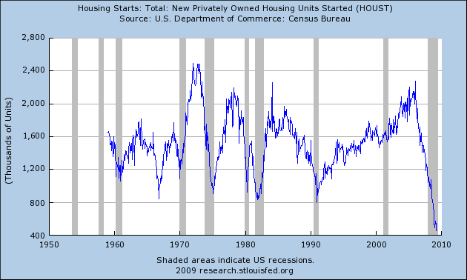
Housing starts are already at 40 year lows.
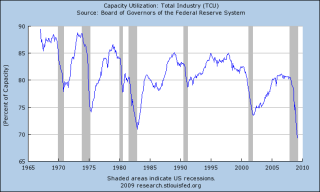
Capacity utilization is also at 40 year lows, meaning there is little incentive for companies to buy new capital equipment.
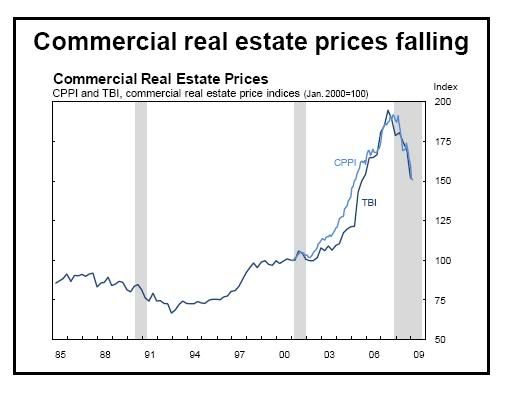
Commercial real estate prices
are falling as well, indicating a lack of demand and therefore no need to build more commercial property.
In short, there is no reason to think investment will bring us out of the recession either.'
Then we have exports. First, remember the US is is a net importer and has been for several decades. That means exports haven't bee a positive contributor to GDP for some time. But most of out trading partners are also in a recession so they have no need to buy things from the US. In other words, don't expect exports to bring us out of the recession either.
Simply put, there are no parts of the economy ready to step up to the plate and take the lead pulling the US out of recession. As a result:
Americans may have to get used to unemployment greater than 8 percent for the first time since 1983 and an economy that won’t grow much beyond 2 percent as a consequence of the lost confidence in consumer credit that shattered financial markets.
By this time next year, "the market will realize that potential growth for the U.S. is no longer 3 percent, but is 2 percent or under," Mohamed El-Erian, chief executive officer of Pacific Investment Management Co., said in an interview with Bloomberg Radio.
Tags:
Economy,
Recommended
(all tags) ::
Previous Tag Versions |
|
|
|
|
|
|
|
|
|
|
|
楼主 |
发表于 31-5-2009 07:38 AM
|
显示全部楼层
看了一篇非常有趣的comment, 更证明这次的涨潮后面有黑手:
Watch the video from Fox Business News. Very interesting! Clear evidence of stock market manipulation by someone:
http://www.foxnews.com/video/index.html?playerId=videolandingpage&streamingFormat=FLASH&referralObject=5036977&referralPlaylistId=playlist
With 2 minutes 30 seconds remaining in the video, Dan Shaffer, President of Shaffer Asset Management, gives
shocking evidence of direct government intervention in the stock market:
“Something strange happened during the last 7 or 8 weeks. Doreen you probably can concur on this -- there was a power underneath the market that kept holding it up and trading the futures. I watch the futures every day and every tick, and a tremendous amount of volume came in a several points during the last few weeks, when the market was just about ready to break, and it shot right up again. Usually toward the end of the day – it happened a week ago Friday, at 7 minutes to 4 o’clock, almost 100,000 S&P futures contracts were traded, and then in the last 5 minutes, up to 4 o’clock, another 100,000 contracts were traded, and lifted the Dow from being down 18 to up over 44 or 50 points in 7 minutes. That is 10 to 20 billion dollars to be able to move the market in such a way. Who has that kind of money to move this market?
On top of that, the market has rallied up during the stress test uncertainty and moved the bank stocks up, and the bank stocks issued secondaries – they issues stock – they raised capital into this rally. It was perfect text book setup of controlling the markets – now that the stock has been issued…” [interrupted by Richard Suttmeier].
全部的证据都说明Goldman Sach就是这个manipulator, GS 不可能拿出100-200亿来炒股,唯一可能是后台老板是Fed
|
|
|
|
|
|
|
|
|
|
|
|
楼主 |
发表于 31-5-2009 11:26 PM
|
显示全部楼层
Ugh! Gas hits $2.50 Drivers already feeling the recession's pain suffer as the average price of a gallon rockets more than 50% since the start of the year.EMAIL |
PRINT |
SHARE |
RSS
By CNNMoney.com staff
May 31, 2009: 8:17 AM ET
Photos

Pontiac's road to oblivion
The Pontiac most of us know today really started in the early 1960s. Over the years, there have been several attempts to bring it back.View Photos
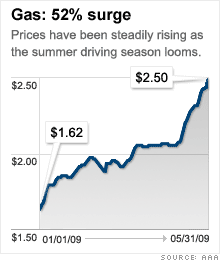
NEW YORK (CNNMoney.com) -- The price of gas, rising for the 33rd straight day, has reached $2.50 a gallon, motorist group AAA reported Sunday.
The spike of more than 20% in a month is hitting Americans in their wallets and causing concern among some experts.
The jump in one of consumers' staple purchases comes at a fragile time for the economy. Recently some measures of housing, spending and credit have hinted that the most severe parts of the recession may be easing.
At the same time, gas has jumped in price as the American auto industry is on the verge of a dramatic reshaping amid plummeting vehicle sales.
According to AAA, the national average price for a gallon of regular unleaded gas has edged up to $2.502, from $2.488 the day before.
Late spring is typically a time of year when people drive more. But rising gas prices could cause people to stay home. That would mean less spending, which could dampen governments efforts to stimulate the economy.
0:00
/2:24[url=]Summer pump jump[/url]
"There's way too much optimism about a driving season lift," said Tom Kloza, chief oil analyst for the Oil Price Information Service.
Kloza said the impact will be especially painful in economic "sore spots" like California, Florida, Arizona and the rural South.
Currently, the highest gas prices are in Hawaii, where prices average $2.789 per gallon, and Alaska, where the average is $2.751.
In the lower 48, the highest prices are in two of the states hardest hit by the recession: California ($2.746) and Michigan ($2.745).
Michigan suffers the highest unemployment rate in the nation -- 12.9%. California is close behind at 11%.
The next most expensive states for filling up are:
- Illinois, $2.692
- Washington, $2.677
- Wisconsin, $2.647
- New York, $2.634
- Indiana, $2.618
- Ohio, $2.618
- Connecticut, $2.615
The cheapest gas can be found in South Carolina, where the average is $2.309 a gallon.
Despite the recent surge, the average price of a gallon of gas remains well below its all-time peak of $4.114 on July 17, 2008.
But the repercussions of the 2008 gas spike are still being felt.
Last year's gas price spike severely hampered demand for SUVs and trucks, hastening the downward spiral for the Big Three automakers.
Chrysler filed for
bankruptcy on April 30
and is awaiting a ruling from a federal judge as to whether it may sell its assets and form a new company. General Motors (GM,
Fortune 500) is expected tofile for bankruptcy
next week and its stock price is trading
below $1 a share
for the first time since the Great Depression. 
很不幸的,又被我讲中了
石油,commodities起不是经济复苏的预兆,而是通膨
美国消费者已经穷剩一条底裤。。。大家为他们祷告吧 |
|
|
|
|
|
|
|
|
|
|
|
 发表于 1-6-2009 12:24 AM
|
显示全部楼层
发表于 1-6-2009 12:24 AM
|
显示全部楼层
原帖由 tanhy 于 31-5-2009 07:38 AM 发表 
看了一篇非常有趣的comment, 更证明这次的涨潮后面有黑手:
Watch the video from Fox Business News. Very interesting! Clear evidence of stock market manipulation by someone:
http://www.foxnews.co ...
谢谢。等了很久才看到一条像样的新闻,你不觉得股市涨得太快了吗?某幕后黑手正在施展吸金大法,我看六月到十月间会有大调整。越晚调整就越可怕。 |
|
|
|
|
|
|
|
|
|
|
|
楼主 |
发表于 1-6-2009 07:58 AM
|
显示全部楼层
原帖由 helloboy 于 1-6-2009 12:24 AM 发表  谢谢。等了很久才看到一条像样的新闻,你不觉得股市涨得太快了吗?某幕后黑手正在施展吸金大法,我看六月到十月间会有大调整。越晚调整就越可怕。 谢谢。等了很久才看到一条像样的新闻,你不觉得股市涨得太快了吗?某幕后黑手正在施展吸金大法,我看六月到十月间会有大调整。越晚调整就越可怕。
我觉得股市起得太快,太假
最可怕的是当目的达到了,这些人会毫不犹豫地离场
Buy on rumor, sell on fact
当股价已经把利好反应出来,就是卖的时候
更何况所谓的利好,是不实在 |
|
|
|
|
|
|
|
|
|
|
|
发表于 1-6-2009 08:06 AM
|
显示全部楼层
原帖由 tanhy 于 1-6-2009 07:58 AM 发表
我觉得股市起得太快,太假
最可怕的是当目的达到了,这些人会毫不犹豫地离场
Buy on rumor, sell on fact
当股价已经把利好反应出来,就是卖的时候
更何况所谓的利好,是不实在
完全赞同。。 就要看今晚US的PMI指数了
如果是上升,就觉得很矛盾了。。 因为学家都预测Unemployment rate 会 hit 到新低
如果没有工钱又何来消费呢? |
|
|
|
|
|
|
|
|
|
|
|
楼主 |
发表于 1-6-2009 09:19 AM
|
显示全部楼层
STI 非常接近我要short 的水平
如果起到2400,离最低点(1450)已经起了65%
STI最强的一次反弹是在97风暴,起了70%
万事俱备,只欠东风 |
|
|
|
|
|
|
|
|
|
|
|
发表于 1-6-2009 09:24 AM
|
显示全部楼层
原帖由 tanhy 于 1-6-2009 09:19 AM 发表
STI 非常接近我要short 的水平
如果起到2400,离最低点(1450)已经起了65%
STI最强的一次反弹是在97风暴,起了70%
万事俱备,只欠东风
现在频频创新高,所以你认为势必会有一次的大调整。。。。
你现在手上有没有票? |
|
|
|
|
|
|
|
|
|
|
|
楼主 |
发表于 1-6-2009 09:38 AM
|
显示全部楼层
原帖由 lemontee 于 1-6-2009 09:24 AM 发表 
现在频频创新高,所以你认为势必会有一次的大调整。。。。
你现在手上有没有票?
我只有N年前的马股,不过那些不是很在乎
主力还是在放在这里
futures 是等于赌博,所以我也不敢玩太大
我只是看到人性的贪,所以才下场娱乐一下,当然也希望赚点家用
只有看到泡沫爆破的迹象我才会加码 |
|
|
|
|
|
|
|
|
|
|
|
发表于 1-6-2009 10:04 AM
|
显示全部楼层
|
|
|
|
|
|
|
|
|
|
|
发表于 1-6-2009 10:15 AM
|
显示全部楼层
|
|
|
|
|
|
|
|
|
|
|
发表于 1-6-2009 10:21 AM
|
显示全部楼层
|
|
|
|
|
|
|
|
|
|
|
楼主 |
发表于 1-6-2009 11:08 AM
|
显示全部楼层
|
|
|
|
|
|
|
|
|
|
|
楼主 |
发表于 1-6-2009 11:12 AM
|
显示全部楼层
其实我不太相信技术分析的主因是因为水能载舟,更能覆舟
你用技术分析来判断走势,炒家用他来设陷阱 |
|
|
|
|
|
|
|
|
|
|
|
楼主 |
发表于 1-6-2009 11:20 AM
|
显示全部楼层
|
|
|
|
|
|
|
|
|
|
|
发表于 1-6-2009 11:35 AM
|
显示全部楼层
原帖由 tanhy 于 1-6-2009 11:20 AM 发表 
东风不只是指数,我更关心Fed的政策
在什么情况下Fed会被逼停止宽松政策?
那大大认为什麼情况之下FED 停止呢?
當銀行拿完$ 之后? |
|
|
|
|
|
|
|
|
|
|
|
发表于 1-6-2009 11:49 AM
|
显示全部楼层
讲真的, 要不要進場, 真的是很難的決定.
有些巳進場赚到$ 的, 可能看了这楼會讲, 哈哈,吃不到葡萄说葡萄酸.
要進場, 真的要有很大的勇氣. |
|
|
|
|
|
|
|
|
|
|
|
楼主 |
发表于 1-6-2009 12:06 PM
|
显示全部楼层
原帖由 alpinev18 于 1-6-2009 11:35 AM 发表
那大大认为什麼情况之下FED 停止呢?
當銀行拿完$ 之后?
那是其中一个可能性
然后中国会不会买美国bond是另一个,美元会跌多凶,inflation 又是另一个 |
|
|
|
|
|
|
|
|
|
|
|
楼主 |
发表于 1-6-2009 12:11 PM
|
显示全部楼层
原帖由 alpinev18 于 1-6-2009 11:49 AM 发表
讲真的, 要不要進場, 真的是很難的決定.
有些巳進場赚到$ 的, 可能看了这楼會讲, 哈哈,吃不到葡萄说葡萄酸.
要進場, 真的要有很大的勇氣.
其实很容易判断
主要是看风险和回酬的对比
1) 就算经济年尾会复苏,现在已经涨过头,1-2月内会盘整
2)如果不幸爆炸,下跌空间有多高? |
|
|
|
|
|
|
|
|
|
|
|
楼主 |
发表于 1-6-2009 01:43 PM
|
显示全部楼层
Bailout NationU.S. Vows To Be Hands-Off Owner Of GMJoann Muller and Brian Wingfield, 05.31.09, 10:19 PM EDT Automaker to get $30 billion in bankruptcy financing from government, which will receive 60% stake.
WASHINGTON -- After strong-arming General Motors and its stakeholders into a painful bankruptcy filing expected Monday, the Obama administration promised to remain a passive investor in America's largest carmaker.
Under the terms of the largely pre-arranged bankruptcy, announced Sunday evening by senior administration officials, U.S. taxpayers will own 60% of GM when its court-supervised restructuring is completed in 60 to 90 days. The Canadian and Ontario governments will own 12%, the United Automobile Workers union 17.5% and unsecured bondholders 10%.
GM终于破产
就算几个月后翻身又如何?他有本事和日本厂较量吗?
美国纳税人真的是丢钱下海
同样的,大马的破桶一早就好关勒
就是因为它我们才会买贵车 |
|
|
|
|
|
|
|
|
|
| |
 本周最热论坛帖子 本周最热论坛帖子
|










 860
860  26
26


