|
查看: 1035|回复: 10
|
cost acc的问题~~><
[复制链接]
|
|
|
我很迷惘啊~
希望大家可以帮下忙><~help~
Explain the following termsused in Management Accounting. Your answer should show the usage, purpose andbenefit of the term. (a)
Contribution Margin (b)
Margin of Safety (c)
Flexible Budget (e)
(Under)/Over Absorbed Overhead (f)
Discounted Cash Flow
各位~多多帮忙~感激不尽啊^^
|
|
|
|
|
|
|
|
|
|
|
|
 发表于 17-6-2010 02:26 PM
|
显示全部楼层
发表于 17-6-2010 02:26 PM
|
显示全部楼层
|
|
|
|
|
|
|
|
|
|
|
发表于 17-6-2010 02:31 PM
|
显示全部楼层
|
|
|
|
|
|
|
|
|
|
|

楼主 |
发表于 17-6-2010 03:02 PM
|
显示全部楼层
><~~~
我没有课本的~
只有几张复印的纸><
不过我试下去library找啦~
谢谢~^^ |
|
|
|
|
|
|
|
|
|
|
|
发表于 15-2-2011 04:38 PM
|
显示全部楼层
回复 1# vickytay
(a) Contribution Margin (取自accountingformanagement.com)Definition of Contribution Margin Ratio:The contribution margin as a percentage of total sales is referred to ascontribution margin ratio (CM Ratio). Formula of CM Ratio:Formula or equation of CM ratio is as follows:[ CM Ratio = Contribution Margin / Sales ] This ratio is extensively used in cost-volume profit calculations. Calculation / Computation of Contribution Margin Ratio:Example:Consider the following contribution margin income statement of A. Q. Asem private Ltd.in which sales revenues, variable expenses, and contribution margin are expressed as percentage of sales. | Total | Per Unit | Percent of Sales | | Sales (400 units) | $100,000 | $250 | 100% | | Less variable expenses | 60,000 | 150 | 60% | | | ------------ | ------------ | ------------ | | Contribution margin | $40,000 | $100 | 40% | | | | ====== | ====== | | Less fixed expenses | 35,000 | | | | | ------------ | | | | Net operating income | $5,000 | | | | | ====== | | |
Calculate contribution margin ratio
|
|
According to above data of A. Q. Asem private Ltd. the computations are: Contribution Margin Ratio = (Contribution Margin / Sales) × 100 = ($40,000 / $100,000) × 100 = 40% In a company that has only one product such as A. Q. Asem CM ratio can also be calculated as follows: Contribution Margin Ratio = (Unit contribution margin / Unit selling price) × 100 = ($100 / $250) × 100 = 40% Importance of Contribution Margin Ratio:The CM ratio is extremely useful since it shows how the contribution margin will be affected by a change in total sales. To illustrate notice that A. Q. Asem has a CM ratio of 40%. This means that for each dollar increase in sales, total contribution margin will increase by 40 cents ($1 sales × CM ratio of 40%). Net operating income will also increase by 40 cents, assuming that fixed cost do not change. The impact on net operating income of any given dollar change in total sales can be computed in seconds by simply applying the contribution margin ratio to the dollar change. For example if the A. Q. Asem plans a $30,000 increase in sales during the coming month, the contribution margin should increase by $12,000 ($30,000 increased sales × CM ratio of 40%). As we noted above, Net operating income will also increase by $12,000 if fixed cost do not change. This is verified by the following table: | | Sales Volume | Percent of Sales | | | Percent | Expected | Increase | | Sales | $100,000 | $130,000 | $30,000 | 10% | | Less variable expenses | 60,000 | 78,000 | 18,000 | 60% | | | --------- | -------- | -------- | ------ | | Contribution margin | 40,000 | 52,000 | 12,000 | 40% | | Less fixed expenses | 35,000 | 35,000 | 0 | ====== | | | --------- | -------- | -------- | | | Net operating income | 5,000 | 17,000* | 12,000 | | | | ====== | ====== | ====== | |
|
*Expected net operating income of $17,000 can also be calculated directly by using the following formula: [P*= (Sales × CM ratio) – Fixed Cost] P* = Profit Review Problems roblem 1: roblem 1:Sales = $5,000,000
CM = 0.40
Fixed cost = $1,600,000 Calculate Profit. Solution:P = (Sales × CM ratio) – Fixed Cost
P = ($5,000,000 × 0.4) – $1,600,000
P = $2,000,000 – $1,600,000
= $400,000 Problem 2:A company has budgeted sales of $200,000, a profit of $60,000 and fixed expenses of $40,000. Calculate contribution margin ratio. Solution:P = (Sales × CM ratio) – Fixed Cost
$60,000 = ($200,000 × CM ratio) – $40,000
$60,000 + $40,000 = ($200,000 × CM ratio)
CM ratio = $100,000 / $200,000
= 0.5
|
|
|
|
|
|
|
|
|
|
|
|
发表于 15-2-2011 04:40 PM
|
显示全部楼层
回复 1# vickytay
(b) Margin of Safety (取自accountingformanagement.com)Definition and Explanation:Margin of safety (MOS) is the excess of budgeted or actual sales over the break even volume of sales. It stats the amount by which sales can drop before losses begin to be incurred. The higher the margin of safety, the lower the risk of not breaking even. Formula of Margin of Safety:The formula or equation for the calculation of margin of safety is as follows: [Margin of Safety = Total budgeted or actual sales − Break even sales] The margin of safety can also be expressed in percentage form. This percentage is obtained by dividing the margin of safety in dollar terms by total sales. Following equation is used for this purpose. [Margin of Safety = Margin of safety in dollars / Total budgeted or actual sales] Example:| Sales(400 units @ $250) | $100,000 | | Break even sales | $87,500 | Calculate margin of safety |
Calculation:
| | Sales(400units @$250) | $100,000 | | Break even sales | $ 87,500 | | | --------- | | Margin of safety in dollars | $ 12,500 | | | ======= | Margin of safety as a percentage of sales: 12,500 / 100,000 = 12.5% |
It means that at the current level of sales and with the company's current prices and cost structure, a reduction in sales of $12,500, or 12.5%, would result in just breaking even. In a single product firm, the margin of safety can also be expressed in terms of the number of units sold by dividing the margin of safety in dollars by the selling price per unit. In this case, the margin of safety is 50 units ($12,500 ÷ $ 250 units = 50 units). |
|
|
|
|
|
|
|
|
|
|
|
发表于 15-2-2011 04:41 PM
|
显示全部楼层
回复 vickytay
(b) Margin of Safety (取自accountingformanagement.com)Definition and Explanation: ...
cwenloo 发表于 15-2-2011 04:40 PM 
接以上回帖:
Review Problem:Voltar company manufactures and sells a telephone answering machine. The company's contribution margin income statement for the most recent year is given below: Description | Total | Per unit | Percent of Sales | | Sales (20,000 units) | $ 1,200,000 | $60 | 100% | | Less variable expenses | 900,000 | $45 | ?% | | | --------- | -------- | -------- | | Contribution margin | 300,000 | $15 | ?% | | Less fixed expenses | 240,000 | ====== | ===== | | | --------- | | | | Net operating income | 60,000 | | | | | ====== | | |
|
Required: margin of safety of safety both in dollars and percentage form. Solution to Review Problem:Margin of safety = Total sales – Break even sales* = $1,200,000 – $960,000 = $240,000 Margin of safety percentage = Margin of safety in dollars / Total sales = $240,000 / $1,200,000 = 20% *The break even sales have been calculated as follows: Sales = Variable expenses + Fixed expenses + Profit $60Q = $45Q + $240,000 + $0** $15Q = $240,000 Q = $240,000 / $15 per unit Q = 16,000 units; or at $60 per unit. $960,000
|
|
|
|
|
|
|
|
|
|
|
|
|
发表于 15-2-2011 04:45 PM
|
显示全部楼层
回复 1# vickytay
(c) Flexible budget (取自http://classes.bus.oregonstate.edu)
A budget is a plan for the future. Hence, budgets are planning tools, and they are usually prepared prior to the start of the period being budgeted. However, the comparison of the budget to actual results provides valuable information about performance. Therefore, budgets are both planning tools and performance evaluation tools. Usually, the single most important input in the budget is some measure of anticipated output. For a factory, this measure of output is the number of units of each product produced. For a retailer, it might be the number of units of each product sold. For a hospital, it is the number of patient days (the number of patient admissions multiplied by the average length of stay). The static budget is the budget that is based on this projected level of output, prior to the start of the period. In other words, the static budget is the “original” budget. The static budget variance is the difference between any line-item in this original budget and the corresponding line-item from the statement of actual results. Often, the line-item of most interest is the “bottom line”: total cost of production for the factory and other cost centers; net income for profit centers. The flexible budget is a performance evaluation tool. It cannot be prepared before the end of the period. A flexible budget adjusts the static budget for the actual level of output. The flexible budget asks the question: “If I had known at the beginning of the period what my output volume (units produced or units sold) would be, what would my budget have looked like?” The motivation for the flexible budget is to compare apples to apples. If the factory actually produced 10,000 units, then management should compare actual factory costs for 10,000 units to what the factory should have spent to make 10,000 units, not to what the factory should have spent to make 9,000 units or 11,000 units or any other production level. The flexible budget variance is the difference between any line-item in the flexible budget and the corresponding line-item from the statement of actual results. The following steps are used to prepare a flexible budget: 1.
Determine the budgeted variable cost per unit of output. Also determine the budgeted sales price per unit of output, if the entity to which the budget applies generates revenue (e.g., the retailer or the hospital). 2.
Determine the budgeted level of fixed costs. 3.
Determine the actual volume of output achieved (e.g., units produced for a factory, units sold for a retailer, patient days for a hospital). 4.
Build the flexible budget based on the budgeted cost information from steps 1 and 2, and the actual volume of output from step 3. Flexible budgets are prepared at the end of the period, when actual output is known. However, the same steps described above for creating the flexible budget can be used prior to the start of the period to anticipate costs and revenues for any projected level of output, where the projected level of output is incorporated at step 3. If these steps are applied to various anticipated levels of output, the analysis is called pro forma analysis. Pro forma analysis is useful for planning purposes. For example, if next year’s sales are double this year’s sales, what will be the company’s cash, materials, and labor requirements in order to meet production needs? |
|
|
|
|
|
|
|
|
|
|
|
发表于 15-2-2011 04:49 PM
|
显示全部楼层
回复 1# vickytay
(e) Over/(under) absorption (取自http://basiccollegeaccounting.com)Over or Under Absorbed in Absorption Costing | - Note that as long as planned level of activity and the actual level of activity is not the same there is always an Over or Under Absorption situation
- This is because overhead absorption rate is set at the start of the period based upon an expected level of production
and that during the period, the level of output and
or overheads will be different from the planned overheads and or output.
| - OVER-absorption occurs when the total overhead recovered or absorbed is GREATER than the actual level of overheads for the period.
| - UNDER-absorption occurs when the total overheads recovered or absorbed is LESS than the actual overheads incurred in the period.
| | Illustration: | Company A recovers its overheads based upon direct labor hours. The planned overhead expenditure is $2,500 per month and the planned direct labor hours are 1,000 per month. The results for the first 3 months were as follows:
| Month 1 | Month 2 | Month 3 | | Actual Overhead ($) | 4,000 | 5,000 | 3,500 | | Direct labor hours | 1,000 | 2,000 | 2,000 |
Required: (a)
compute the overheads recovered each month;
(b)
compute the total overheads over/under-absorbed
Solution:
(a)
The pre-determined overhead absorption rate:
= Budgeted overhead per month/Budgeted direct labors per month
=$2,500/1,000 hours=$2.50 per direct labor hour.
| Month 1 | Month 2 | Month 3 | | Actual Overhead ($) | 4,000 | 5,000 | 3,500 | | Direct labor hours (a) | 1,000 | 2,000 | 2,000 | Overhead Recovery per direct labor hour (b) | 2.5 | 2.5 |
2.5 | Overhead recovered or absorbed
(a x b) |
2,500
|
5,000
|
5,000
|
(b)
The monthly over/under absorption of overheads is the difference between the overhead recovered or absorbed and the actual level of overhead for the period | Month 1 | Month 2 | Month 3 | Actual Overhead (a) | 4,000 | 5,000 | 3,500 | Overhead recovered (b) | 2,500 |
5,000 | 5,000 | |
|
|
| Over/(under) absorbed overhead
(a)-(b) |
(1,500)
|
0
|
1,500
|
|
|
|
|
|
|
|
|
|
|
|
|
|
发表于 15-2-2011 04:51 PM
|
显示全部楼层
回复 1# vickytay
(f) Discounted Cash Flow (取自http://www.investopedia.com)Discounted Cash Flow - DCF

What Does Discounted Cash Flow - DCF Mean?
A valuation method used to estimate the attractiveness of an investment opportunity. Discounted cash flow (DCF) analysis uses future free cash flow projections and discounts them (most often using the weighted average cost of capital) to arrive at a present value, which is used to evaluate the potential for investment. If the value arrived at through DCF analysis is higher than the current cost of the investment, the opportunity may be a good one.
Calculated as:
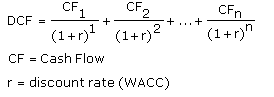
Also known as the Discounted Cash Flows Model. |
|
|
|
|
|
|
|
|
|
|
|
发表于 18-2-2011 10:01 AM
|
显示全部楼层
本帖最后由 50912cmea 于 18-2-2011 10:08 AM 编辑
回复 vickytay
(b) Margin of Safety (取自accountingformanagement.com)Definition and Explanation: ...
cwenloo 发表于 15-2-2011 04:40 PM 
Cwenloo大大,
解释得很清楚。。。
Contribution margin ratio = contribution margin/sales × 100
Margin of safety = margin of safety/sales
有更直接的。。。
= net profit/contribution margin 请试试看 
|
|
|
|
|
|
|
|
|
|
| |
 本周最热论坛帖子 本周最热论坛帖子
|










 变色卡
变色卡 千斤顶
千斤顶


 1484
1484  59
59


